
At the Vietnam Electronics Design Contest 2025, organized by the Vietnam Radio Electronics Association with the theme Embedded Systems and AIoT Technology, the VitalX team from the Industrial University of Ho Chi Minh City achieved an excellent result by securing Second Prize overall.
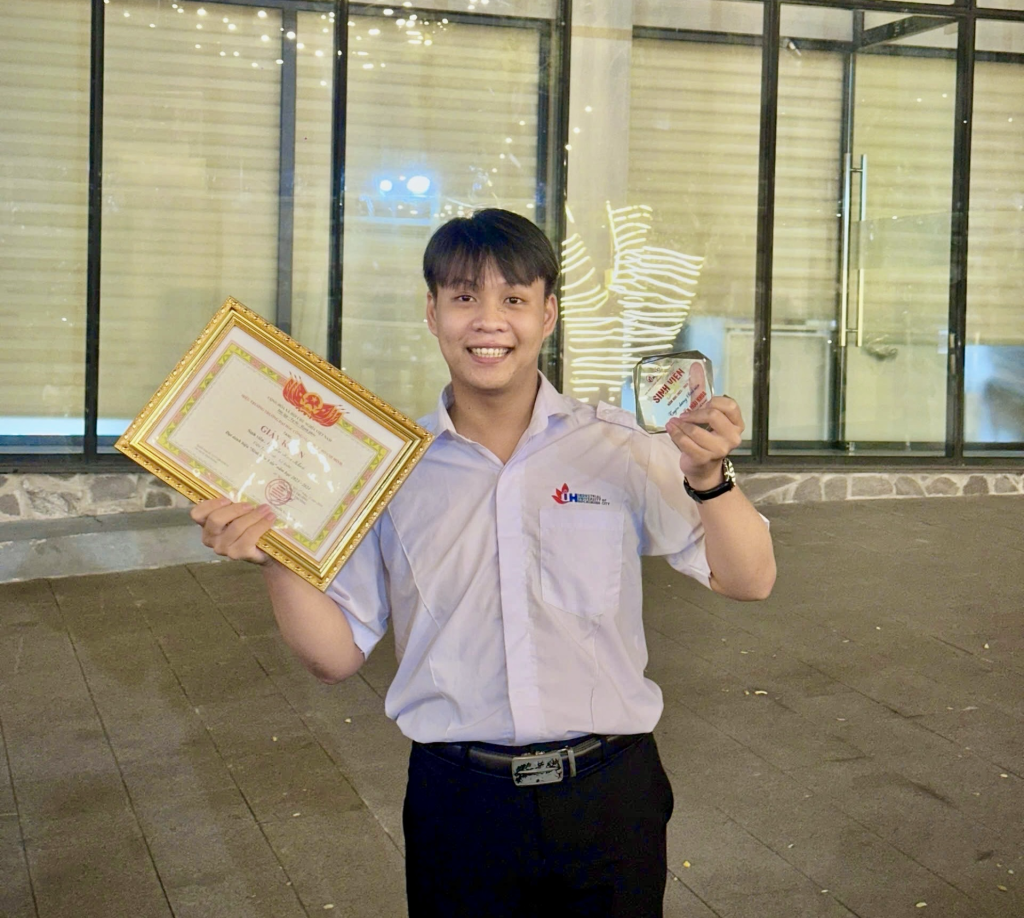
On the evening of December 12, the VitalX team, consisting of two students, Nguyễn Thị Quỳnh Như and Đinh Quang Sơn, under the guidance of Dr. Nguyễn Thế Kỷ Sương, Lecturer at the Faculty of Electronic Technology, IUH, attended the Closing Ceremony and Award Presentation held at the Posts and Telecommunications Institute of Technology.
On the evening of December 12, the VitalX team, consisting of two students, Nguyễn Thị Quỳnh Như and Đinh Quang Sơn, under the guidance of Dr. Nguyễn Thế Kỷ Sương, Lecturer at the Faculty of Electronic Technology, IUH, attended the Closing Ceremony and Award Presentation held at the Posts and Telecommunications Institute of Technology.

The VitalX team from IUH, shown on the left, proudly received Second Prize at the competition
According to the Organizing Committee, this year’s contest attracted 141 teams from 27 universities and academies nationwide. Many prestigious institutions participated, including the Posts and Telecommunications Institute of Technology, Hanoi University of Science and Technology, Vietnam National University Hanoi, and Vietnam National University Ho Chi Minh City. Others included the Industrial University of Ho Chi Minh City, the University of Da Nang, the University of Transport and Communications, Phenikaa University, Hanoi University of Industry, Dong A University, and others. Teams came from all over the country: 57 from the North, 47 from the South, and 37 from the Central region. This wide distribution reflected the high level of competition.
According to the Organizing Committee, this year’s contest attracted 141 teams from 27 universities and academies nationwide. Many prestigious institutions participated, including the Posts and Telecommunications Institute of Technology, Hanoi University of Science and Technology, Vietnam National University Hanoi, and Vietnam National University Ho Chi Minh City. Others included the Industrial University of Ho Chi Minh City, the University of Da Nang, the University of Transport and Communications, Phenikaa University, Hanoi University of Industry, Dong A University, and others. Teams came from all over the country: 57 from the North, 47 from the South, and 37 from the Central region. This wide distribution reflected the high level of competition.
The project impressed the Judging Panel thanks to its novelty in integrating multiple sensors into a single device and its high level of technical completeness. The signal processing system was systematically developed, and the product operated stably beyond laboratory conditions, with a comprehensive solution model covering devices, applications, and the cloud platform. The judges highly appreciated the team’s ability to design the hardware from the chip level without using ready-made modules, as well as the system’s stable operation and strong potential for future expansion.
After the competition, a representative of the VitalX team stated that the group was proud that the product could make a practical contribution to the domestic biomedical field and expressed sincere gratitude for the dedicated guidance of their supervising lecturer and the strong support from the University. In the coming period, the team plans to optimize the hardware, extend battery life, improve signal stability, enhance processing algorithms, and expand real-world testing, aiming to build a multi-sensor dataset for AI research and gradually move toward product commercialization.
According to the Organizing Committee, this year’s contest attracted 141 teams from 27 universities and academies nationwide. Many prestigious institutions participated, including the Posts and Telecommunications Institute of Technology, Hanoi University of Science and Technology, Vietnam National University Hanoi, and Vietnam National University Ho Chi Minh City. Others included the Industrial University of Ho Chi Minh City, the University of Da Nang, the University of Transport and Communications, Phenikaa University, Hanoi University of Industry, Dong A University, and others. Teams came from all over the country: 57 from the North, 47 from the South, and 37 from the Central region. This wide distribution reflected the high level of competition.
The project impressed the Judging Panel thanks to its novelty in integrating multiple sensors into a single device and its high level of technical completeness. The signal processing system was systematically developed, and the product operated stably beyond laboratory conditions, with a comprehensive solution model covering devices, applications, and the cloud platform. The judges highly appreciated the team’s ability to design the hardware from the chip level without using ready-made modules, as well as the system’s stable operation and strong potential for future expansion.
After the competition, a representative of the VitalX team stated that the group was proud that the product could make a practical contribution to the domestic biomedical field and expressed sincere gratitude for the dedicated guidance of their supervising lecturer and the strong support from the University. In the coming period, the team plans to optimize the hardware, extend battery life, improve signal stability, enhance processing algorithms, and expand real-world testing, aiming to build a multi-sensor dataset for AI research and gradually move toward product commercialization.

The VitalX team is presenting their project at the competition
According to Dr. Nguyễn Thế Kỷ Sương, supervising lecturer, the success of the VitalX team demonstrates the technical implementation capability, practical testing skills, and problem-solving mindset of IUH students. He expressed his hope that young research groups within the Faculty and the University will continue to foster innovation and pursue interdisciplinary research directions such as biomedical engineering, electronics, and AIoT. This approach is expected to help form successive research teams capable of developing products into long-term research platforms and practical applications, contributing to the training of high-quality engineers for society.
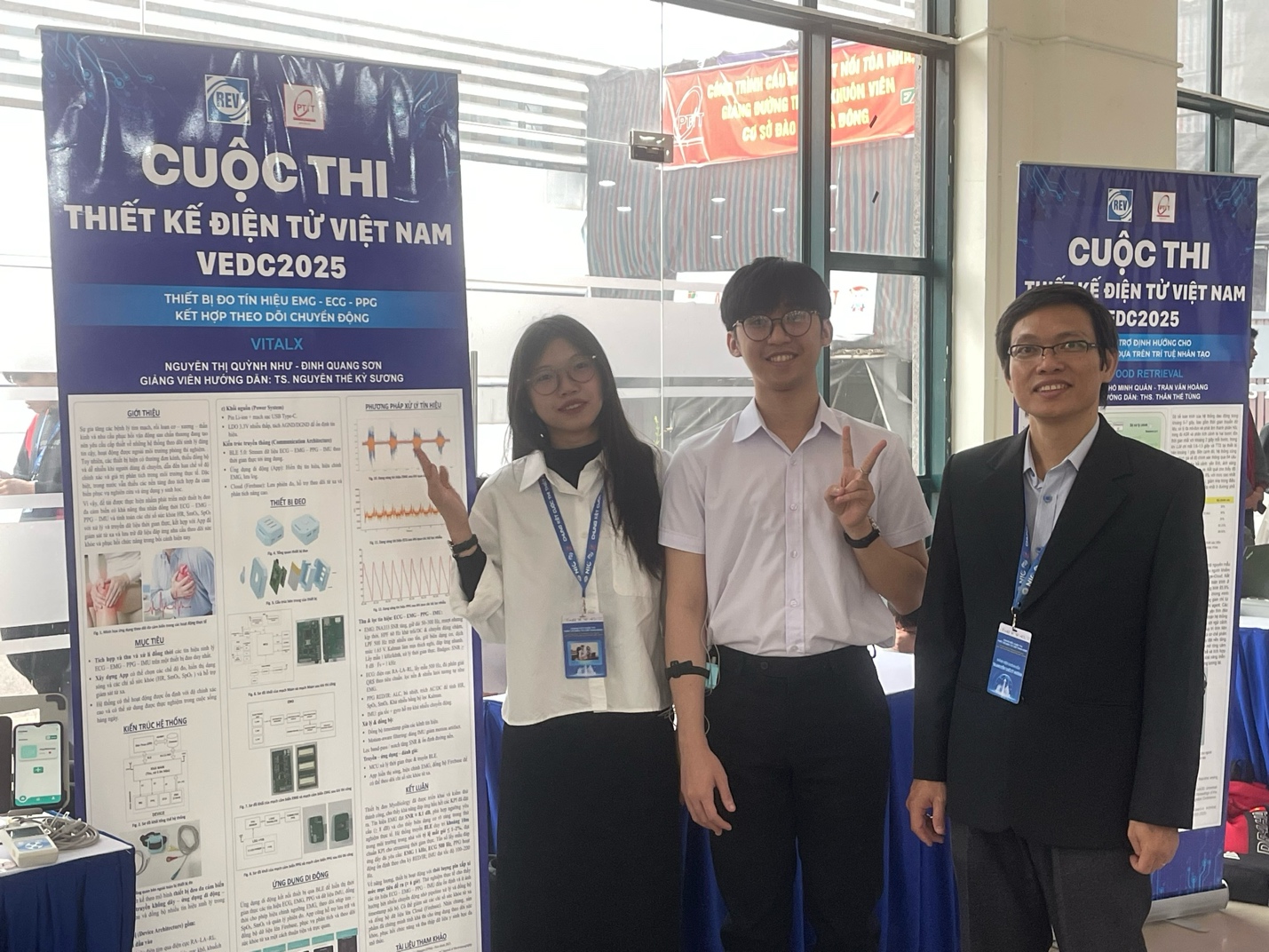 Dr. Nguyễn Thế Kỷ Sương, supervising lecturer, is together with the VitalX team at the competition
At the contest, First Prize was awarded to the IDS PTIT team from the Posts and Telecommunications Institute of Technology.
Two Second Prizes were awarded to teams from the Industrial University of Ho Chi Minh City and the Vietnam Korea University of Information and Communication Technology.
Three Third Prizes went to teams from the University of Science and Technology, the University of Danang, the University of Information Technology, Vietnam National University Ho Chi Minh City, and the Posts and Telecommunications Institute of Technology.
Four Consolation Prizes were awarded to teams from the University of Technical Education, the University of Danang, the University of Science, Vietnam National University, Ho Chi Minh City, the School of Electrical and Electronic Engineering, Hanoi University of Science and Technology, and the Posts and Telecommunications Institute of Technology.
Two Second Prizes were awarded to teams from the Industrial University of Ho Chi Minh City and the Vietnam Korea University of Information and Communication Technology.
Three Third Prizes went to teams from the University of Science and Technology, the University of Danang, the University of Information Technology, Vietnam National University Ho Chi Minh City, and the Posts and Telecommunications Institute of Technology.
Four Consolation Prizes were awarded to teams from the University of Technical Education, the University of Danang, the University of Science, Vietnam National University, Ho Chi Minh City, the School of Electrical and Electronic Engineering, Hanoi University of Science and Technology, and the Posts and Telecommunications Institute of Technology.