
The Euréka Awards 2025 featured 15 fields of competition: Information Technology; Food Technology; Administration – Legal Studies; Chemistry; Educational Science; Agricultural Science; Social Science; Medical – Pharmaceutical Science; Economics; Engineering – Technology; Urban Planning – Architecture – Construction; Biology; Natural Resources – Environment; Culture – Arts; and Physics. Among these, the student team from the Industrial University of Ho Chi Minh City (IUH) excelled, winning First Prize in the Engineering – Technology category.
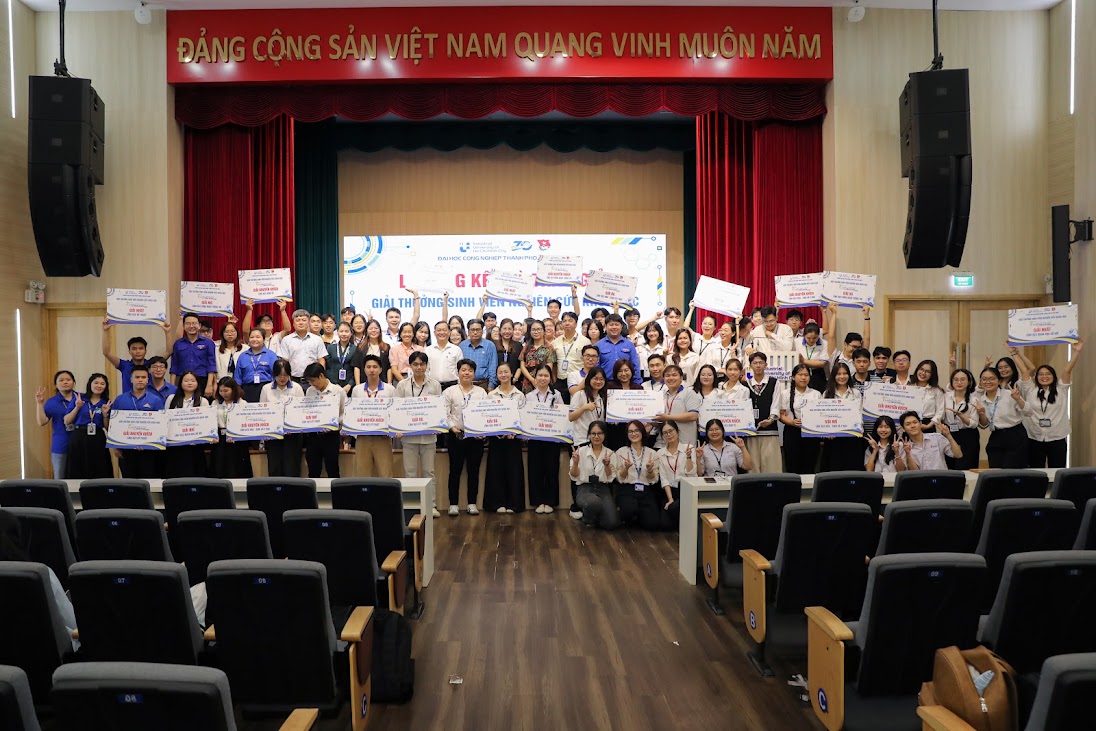
On December 7, the Closing Ceremony and Award Presentation of the Euréka Student Scientific Research Awards 2025 took place at Vietnam National University Ho Chi Minh City. The awards are organized annually by the Ho Chi Minh City Youth Union in collaboration with Vietnam National University.
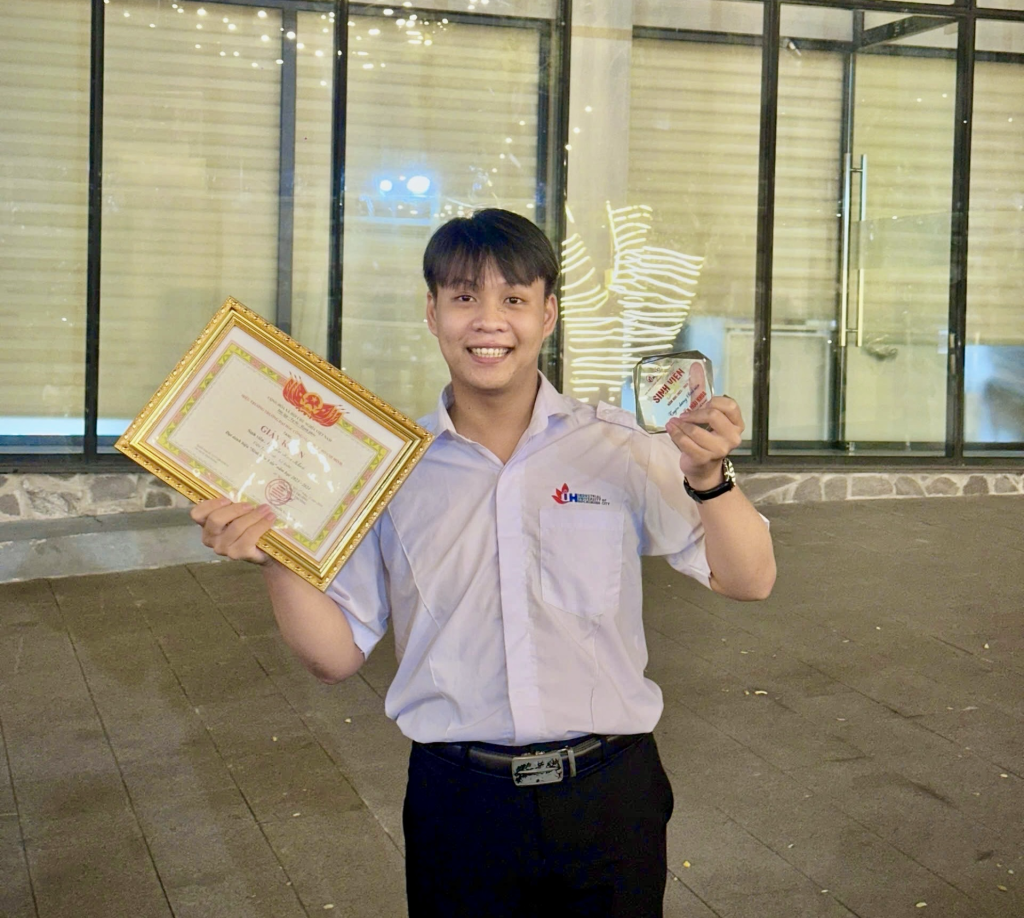
 IUH research team receiving the award at Vietnam National University Ho Chi Minh City
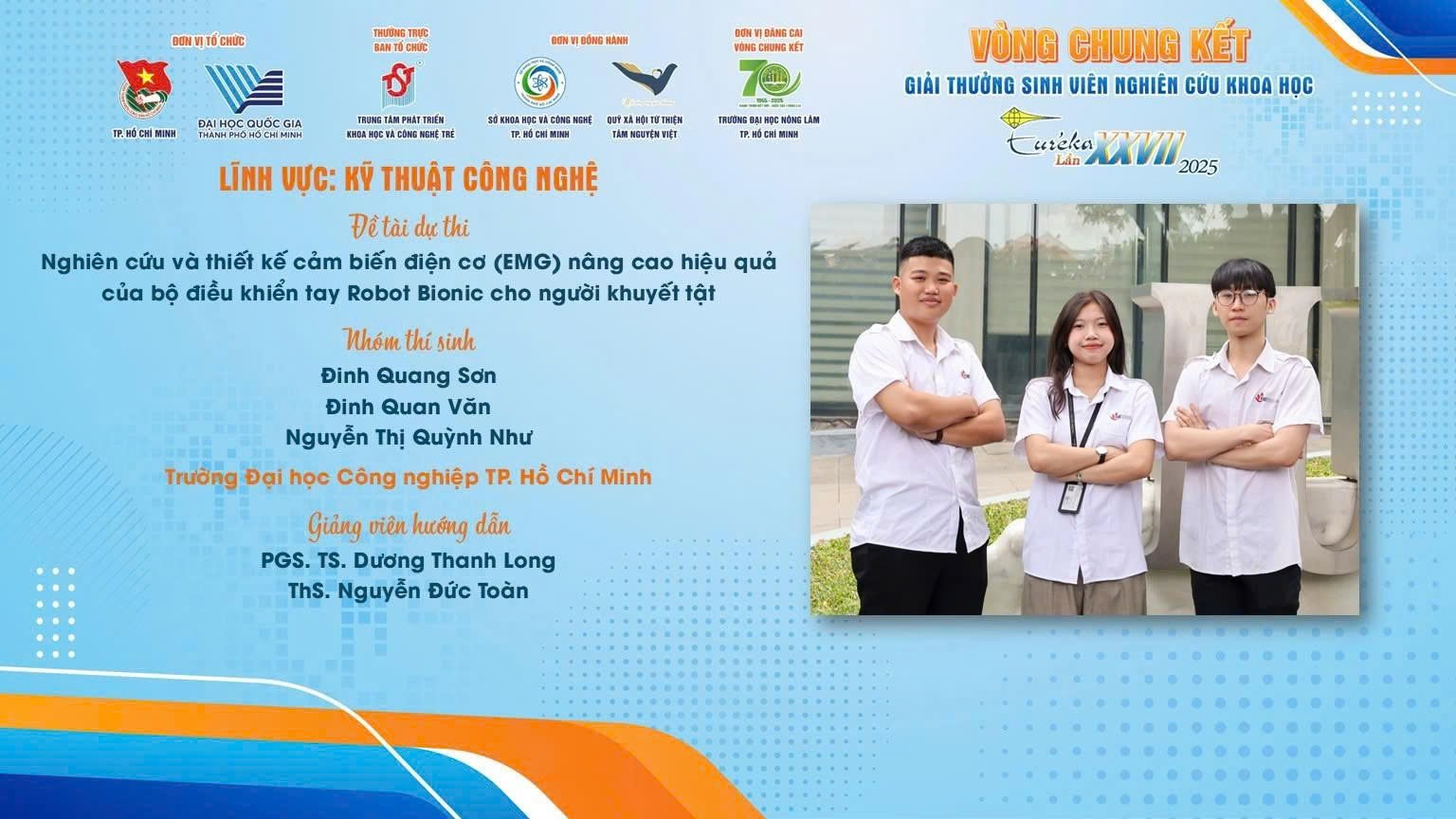
The IUH team Đinh Quang Sơn, Đinh Quan Văn, and Nguyễn Thị Quỳnh Như competed with the research project titled:
“Research and Design of an Electromyography (EMG) Sensor Enhancing Controller Performance for Bionic Hand Robots for People with Disabilities.”
Assoc supervised the project. Assoc. Prof. Dr. Dương Thanh Long – Deputy Dean of the Faculty of Electrical Engineering Technology, and MSc. Nguyễn Đức Toàn – Lecturer of the same faculty.
According to the team, the research idea stemmed from three primary motivations:
The number of people in Vietnam living with upper-limb disabilities remains high due to workplace accidents, traffic incidents, and congenital conditions.
Stories and conversations with people with disabilities helped the team understand their need for greater independence and reduced reliance on family members.
Existing assistive technologies are often expensive and inaccessible for most Vietnamese individuals with disabilities.
These reasons inspired the team to pursue a human-centered, feasible, and highly applicable solution.
“Research and Design of an Electromyography (EMG) Sensor Enhancing Controller Performance for Bionic Hand Robots for People with Disabilities.”
Assoc supervised the project. Assoc. Prof. Dr. Dương Thanh Long – Deputy Dean of the Faculty of Electrical Engineering Technology, and MSc. Nguyễn Đức Toàn – Lecturer of the same faculty.
According to the team, the research idea stemmed from three primary motivations:
The number of people in Vietnam living with upper-limb disabilities remains high due to workplace accidents, traffic incidents, and congenital conditions.
Stories and conversations with people with disabilities helped the team understand their need for greater independence and reduced reliance on family members.
Existing assistive technologies are often expensive and inaccessible for most Vietnamese individuals with disabilities.
These reasons inspired the team to pursue a human-centered, feasible, and highly applicable solution.
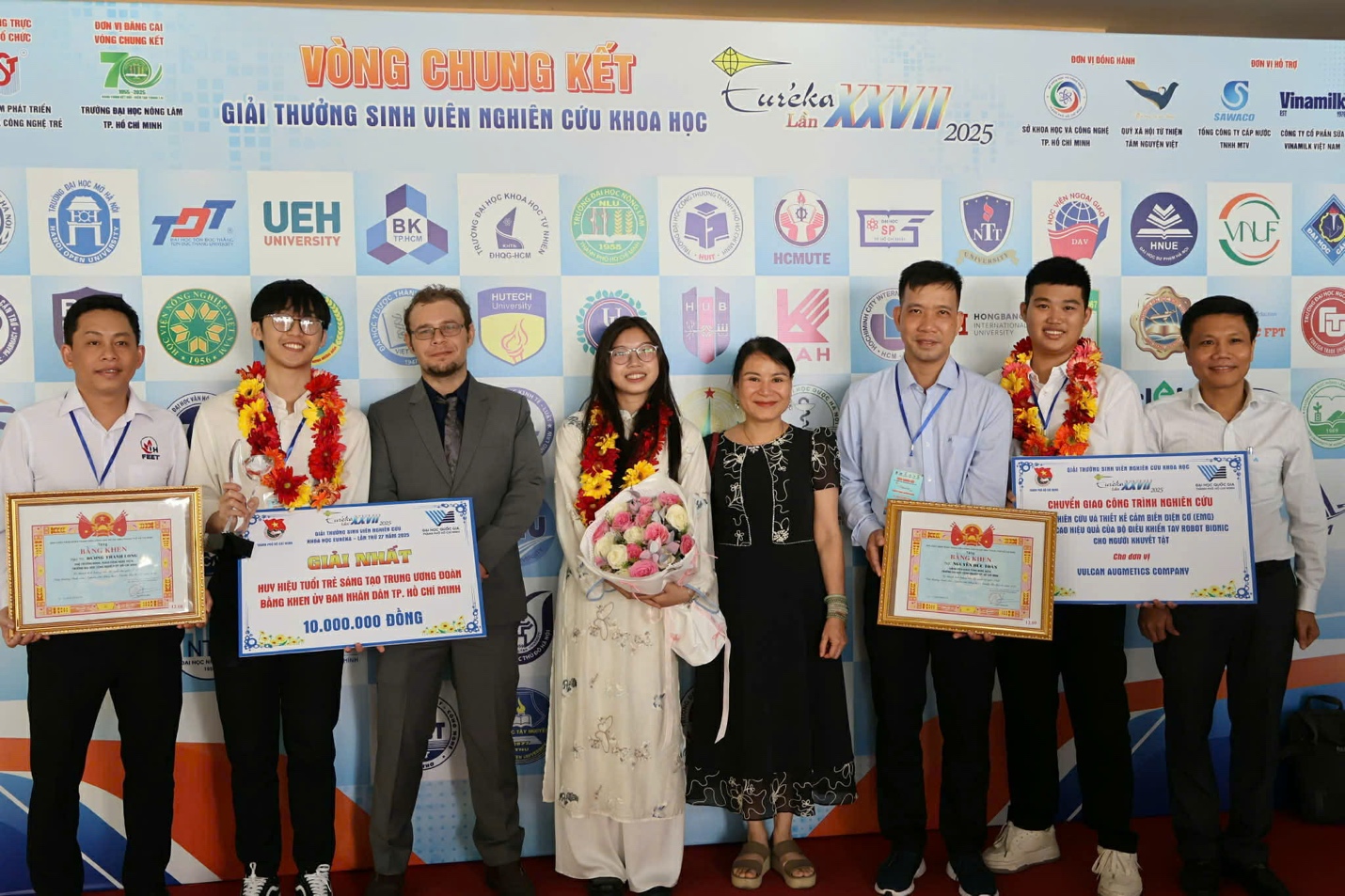
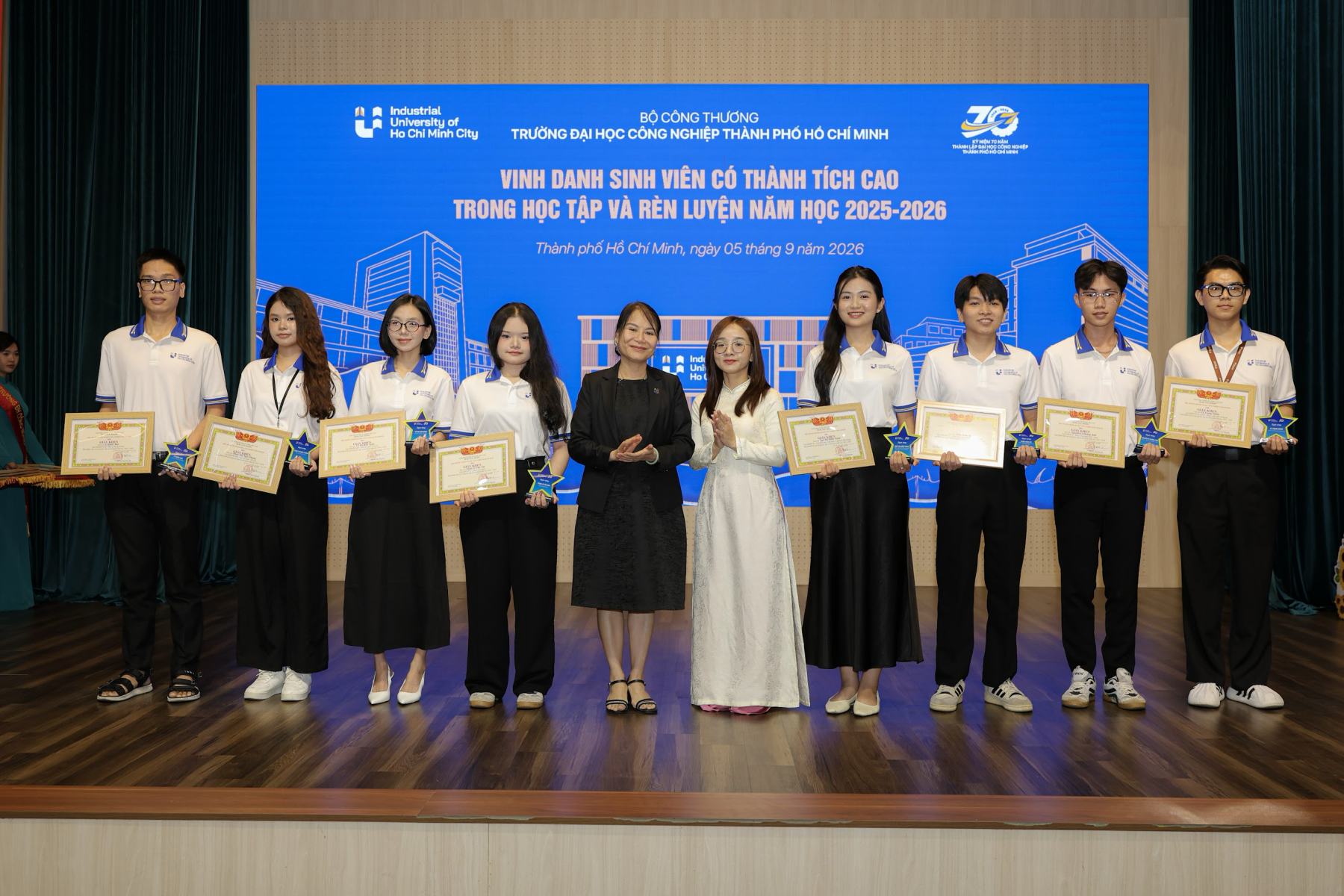
Assoc. Prof. Dr. Đàm Sao Mai – Vice President of IUH (center), Assoc. Prof. Dr. Trần Thanh Ngọc – Dean of the Faculty of Electrical Engineering Technology (far right), and the research team at the awarding ceremony
Assoc. Prof. Dr. Dương Thanh Long shared:
“The biggest challenge for the team was simultaneously approaching multiple new areas of knowledge, such as EMG signals, low-noise analog circuitry, and digital signal processing. They also had to independently design and fabricate hardware, simulate systems, and conduct experiments within a limited time. Because EMG signals are highly susceptible to noise, the circuits and algorithms required constant refinement, creating significant pressure. However, by dividing tasks clearly, conducting multiple prototype iterations, and regularly discussing technical issues with lecturers, the team overcame each challenge and completed their product.”
For him, the most crucial factor was the project’s humanitarian purpose, which gave the students great motivation..
The team shared:
“Winning First Prize at Euréka is an invaluable recognition. It affirms that our chosen research direction EMG sensors and bionic robotic hands is meaningful and practical. This achievement motivates us to continue deeper research in biomedical devices, assistive robotics, and intelligent control systems in our graduate studies and future careers. It also encourages us to pursue scientific publication, improve our prototype, and seek collaboration with enterprises to bring our research closer to people with disabilities.”
Wanting to inspire other IUH students interested in research, Đinh Quang Sơn offered heartfelt advice:
“Start with a problem close to you. Don’t wait until you ‘become good enough’ learn as you go. Find a dedicated supervisor and a group of teammates who share the same goal. Accept trial and error, move forward step by step with persistence, and good results will come as a well-deserved reward.”
“The biggest challenge for the team was simultaneously approaching multiple new areas of knowledge, such as EMG signals, low-noise analog circuitry, and digital signal processing. They also had to independently design and fabricate hardware, simulate systems, and conduct experiments within a limited time. Because EMG signals are highly susceptible to noise, the circuits and algorithms required constant refinement, creating significant pressure. However, by dividing tasks clearly, conducting multiple prototype iterations, and regularly discussing technical issues with lecturers, the team overcame each challenge and completed their product.”
For him, the most crucial factor was the project’s humanitarian purpose, which gave the students great motivation..
The team shared:
“Winning First Prize at Euréka is an invaluable recognition. It affirms that our chosen research direction EMG sensors and bionic robotic hands is meaningful and practical. This achievement motivates us to continue deeper research in biomedical devices, assistive robotics, and intelligent control systems in our graduate studies and future careers. It also encourages us to pursue scientific publication, improve our prototype, and seek collaboration with enterprises to bring our research closer to people with disabilities.”
Wanting to inspire other IUH students interested in research, Đinh Quang Sơn offered heartfelt advice:
“Start with a problem close to you. Don’t wait until you ‘become good enough’ learn as you go. Find a dedicated supervisor and a group of teammates who share the same goal. Accept trial and error, move forward step by step with persistence, and good results will come as a well-deserved reward.”