



The “University – Enterprise – Artificial Intelligence” model proposed by the Industrial University of Ho Chi Minh City (IUH) at the seminar was recognized as a breakthrough direction in training and retraining high-quality human resources—designed to both meet and lead labor market demands, contributing to the realization of the vision outlined in Resolution No. 71-NQ/TW (August 22, 2025) of the Politburo on education and training development.
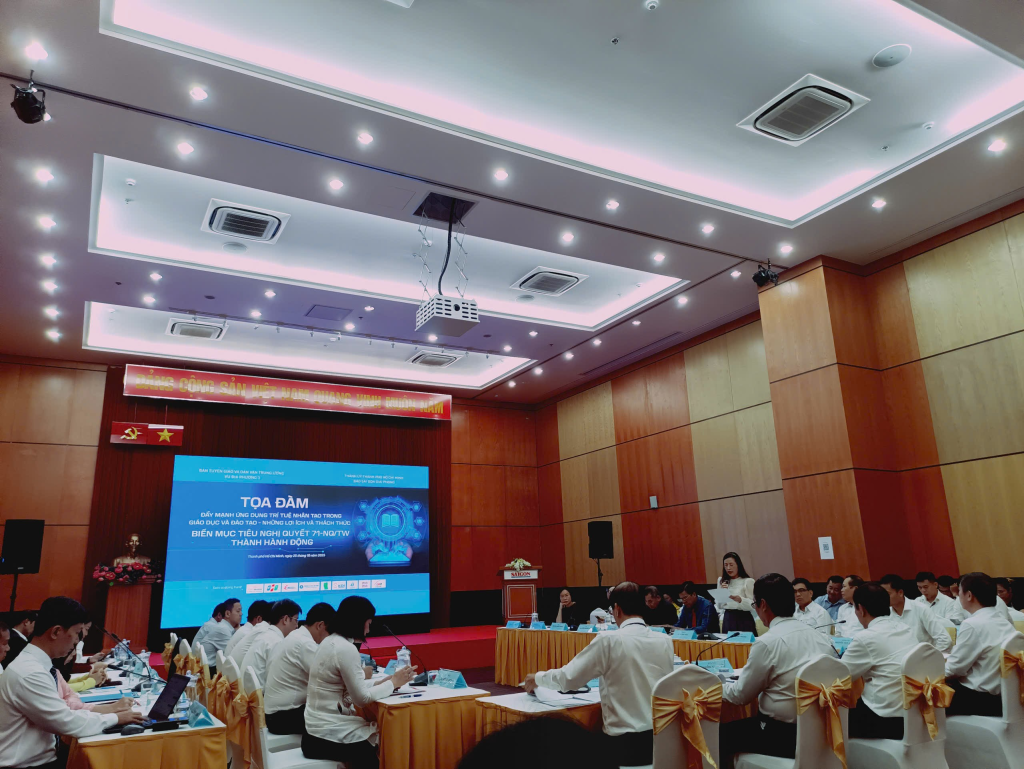
On October 25, 2025, at the headquarters of Sài Gòn Giải Phóng Newspaper, the Central Propaganda Commission, the Central Mass Mobilization Commission, and Sài Gòn Giải Phóng Newspaper co-organized a seminar titled “Promoting the Application of Artificial Intelligence in Education and Training – Benefits and Challenges.” The event concretized the spirit of Resolution 71-NQ/TW of the Politburo and Resolution 281/NQ-CP of the Government on breakthroughs in education and training, emphasizing the task of “comprehensive digital transformation, universal access to digital technology, and strong application of artificial intelligence in education.”
IUH participated in the seminar by presenting a paper with several practical proposals for applying AI in education and training. The event gathered representatives from central and local management agencies, educational institutions, scientists, and enterprises.
.
Three Key Roles of AI from IUH’s Perspective
At the seminar, Assoc. Prof. Dr. Đàm Sao Mai, Vice President of IUH, on behalf of President Dr. Phan Hồng Hải, delivered a groundbreaking presentation titled: “The University – Enterprise – Artificial Intelligence Model: A Breakthrough in Training and Retraining High-Skilled Human Resources to Meet and Lead the Labor Market.”
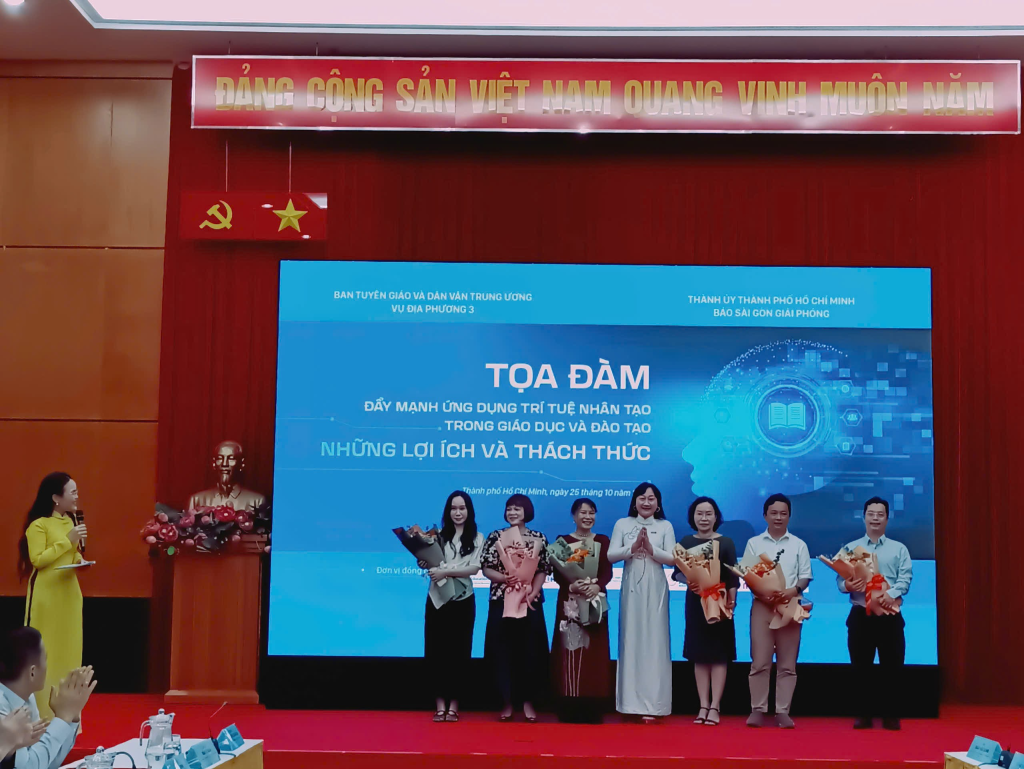
Assoc. Prof. Dr. Đàm Sao Mai explained: “We are facing a paradox—on one side are young people with degrees but no jobs, and on the other, businesses suffering from a shortage of skilled workers. The root cause lies in the ‘skills gap’: technology evolves by the month, but education programs are still updated by the year.”
According to the World Economic Forum (WEF), up to 44% of workers’ core skills are expected to change within the next five years. In Vietnam, 73% of employers struggle to find candidates with adequate digital skills, and 46% of enterprises face difficulties in attracting talent with the right competencies.
IUH’s “University – Enterprise – Artificial Intelligence” model places AI at the center—as a “central nervous system,” creating a continuous value loop among the three entities.
Assoc. Prof. Dr. Đàm Sao Mai outlined three critical roles of AI in this model:
AI as the “Lighthouse” for Training Forecast and Orientation: IUH proposes building a National AI Platform for Skills Analytics and Forecasting, utilizing natural language processing and machine learning to analyze large datasets from job postings, professional networks, sector reports, and policy documents. This would produce a real-time “dynamic skills map,” allowing universities to update their flexibility in response to changing market demands.
AI as the “Architect” of Practical Learning Experiences: Through technologies like Digital Twin and Virtual Laboratories, students can “intern” in simulated enterprise environments. For instance, automotive engineering students can work in a virtual electric vehicle assembly plant; agricultural students can manage a smart farm; cybersecurity students can train in simulated attack-defense networks.
AI as the “Companion” for Lifelong Learning: IUH suggests developing an Agile Reskilling Platform that uses AI to design personalized skill roadmaps for engineers and employees. The system would automatically recommend short courses and certifications suited to each learner’s evolving career needs.
Risk Management and Responsible AI Ecosystem
The integration of AI into education offers significant benefits, including expanding access to learning, promoting personalized education, enhancing self-learning and teaching efficiency, and fostering lifelong learning habits. However, challenges remain: the digital divide, ethical concerns, data security, content reliability, and overreliance on technology.
Recognizing these risks, IUH proposed specific governance solutions to ensure the responsible and sustainable adoption of AI. Specifically, on algorithmic bias, it proposed establishing a National or Inter-University AI Ethics Council for Education to set standards of fairness, transparency, and accountability, thereby ensuring that key decisions remain human-centered.
On Data Security and Privacy: Quickly finalize a legal framework for personal data protection in education, aligned with Decree No. 13/2023/NĐ-CP. Promote open-source technologies and national digital literacy and cybersecurity awareness programs.
On Erosion of Critical Thinking: Redefine the teacher’s role as a “learning environment architect”—guiding students to use AI as a “thinking partner” rather than an “answer machine.” Reorient assessment methods by reducing multiple-choice tests and increasing real-world interdisciplinary projects that require creativity.
IUH’s Strategic Recommendations
On behalf of the University, Assoc. Prof. Dr. Đàm Sao Mai proposed three strategic recommendations to address the mismatch between training and labor market needs:
- For the Ministry of Education and Training: Issue a Circular providing detailed guidance on AI applications in higher education—clearly defining what is permissible, what requires caution, and the minimum standards for ethics and data protection. This will serve as a legal foundation for universities to innovate confidently.
- For the Government: Establish a Digital Transformation Fund for Higher Education with an annual budget of VND 500–1,000 billion, modeled after the National Technology Innovation Fund (NATIF), with a focus on prioritizing projects that involve enterprise co-investment. The fund should provide 70–80% cost support for universities in disadvantaged regions to ensure inclusiveness.
- For the Business Community: Encourage enterprises to shift from being employers to strategic partners and co-creators of talent. Sharing data, processes, and experts for teaching, or co-investing in virtual labs, should be viewed as profitable investments, yielding a workforce ready to create value from the outset.
A Call for a National Innovation Alliance
Assoc. Prof. Dr. Đàm Sao Mai concluded: “The ‘skills gap’ is not just an economic term—it measures the distance between our reality and our aspirations; it is a matter of national destiny. We need an ‘Innovation Alliance' united effort among the Government, Universities, and Enterprises. The Industrial University of Ho Chi Minh City is committed to taking the lead.”
The “University – Enterprise – Artificial Intelligence” model, she affirmed, is not a distant vision but a feasible roadmap to fundamentally address the skills gap, cultivating a new generation of adaptable and pioneering human resources in the digital era.
The presentations, reports, and policy recommendations from the seminar will be compiled and submitted to state management agencies to help remove systemic bottlenecks, create favorable conditions for educational socialization, and mobilize social resources to accelerate the digital transformation of Vietnam’s education sector.